 Tammy Letherer
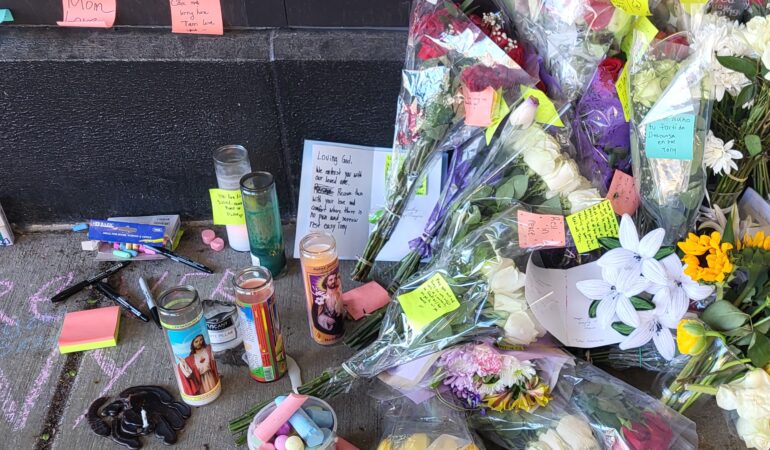
 Last week, something tragic occurred two blocks from my house: a teenager took his life by jumping in front of the morning train. I’d heard the news, but as I walked my dogs the next day, I was still startled to pass the train station and see the memorial. Flowers, notes, and candles were arranged on the sidewalk. Yellow Post-it notes were stuck to the station wall.
Three teenagers stood by silently. I glanced at them and continued on to the coffee shop.
While I waited for my order, it felt terrible that I had just walked by as if what I’d witnessed was an everyday occurrence. His friends were standing right there, and I’d said nothing. So I decided to walk past again.
This time, I paused to read some of the messages. “Rest in Peace, Tony.” “We love you.” One note read: “Loving God, We entrust you with our loved one. Receive him with your love and comfort where there is no pain and sorrow. Rest easy, Tony.”
One of the teenagers was writing in chalk on the sidewalk. I asked if Tony was one of her friends. She nodded.
“So sorry,” I mumbled.
My words felt wholly inadequate. I berated myself as I continued toward home because I didn’t have anything more to say; I should have had words of comfort or wisdom.
Should I have mentioned that my daughter also lost a friend who took her own life as a teenager? How devastating that has been for her? But why would I tell them that? It would just seem depressing. What I would have meant was: I know something of what you feel. I know how momentous this is and how deeply it will affect you.
But that’s not comforting at all.
In the end, I said two lousy words and walked away.
The Weight of Words
As an editor and writer, word count is a practical consideration that I deal with regularly. My fees are typically based on word count. Manuscripts are expected to adhere to industry-standard word counts based on genre, and writers obsess over word count as a way to gauge progress in what is mostly an agonizingly slow endeavor.
That day, I had actually been fuming about word count. I was walking my dogs because I was frustrated with an author I’m working with who wants to slip an excerpt of her boyfriend’s writing into her finished manuscript. His “excerpt” happens to be a complete 114,000-word piece, which is longer than her manuscript. She wants to slap it on the end like, you know, “two books in one!”
Never mind that they’re two different genres, two different topics, and would be a marketing nightmare. So I had to explain that the publisher wouldn’t go for it.
In my own work-in-progress novel, I have mixed feelings about my word count. One moment I’m happy that I’ve generated a couple of hundred pages, the next I’m freaking out because I’m not even to the midpoint and have so many pivotal scenes to add. I worry: What is this bloated, chaotic creature I’m creating?
This is the strange work of being a writer. We count words, cut them, add them, agonize over them. We know their power and their limits.
And sometimes we stand outside a train station with nothing but “so sorry” and feel the inadequacy of language itself.
Why We Write Anyway
The teenagers were standing outside the Jarvis L stop because they wanted people to know that Tony was important. That they knew him. And they remember him. They were writing on yellow Post-it notes and in sidewalk chalk so strangers like me could walk by and read their words.
No one has all the answers or the perfect words. We seldom know exactly how many words are enough. But we write because we want our words—however many there are—to be a reminder: I was here. You were here. This mattered.
The author who wants to include her boyfriend’s manuscript in her book isn’t trying to game the system or pull a fast one. Her boyfriend happens to be dying. Because she loves him, she wants him to see his words in print before it’s too late. She’s trying to say: These words deserve to be read. Let me make sure they’re not forgotten—that he is not forgotten.
Even my pathetic “so sorry” outside the train station was an attempt to say: I see you. I see your grief. I witnessed this moment and I won’t just walk by as if it’s nothing.
Words fail us all the time. They’re woefully inadequate against the weight of grief, the complexity of love, the mystery of being alive at all.
Use them anyway.
Use them to signal presence. To witness. To uplift. To remember. To say you were here and it mattered.
Don’t count the words. Choose words that count.
As Meister Eckhart famously said, “If you only have one prayer your entire life, let it be thank you.”
There, at least, are two powerful words that never fail.