 Tammy Letherer
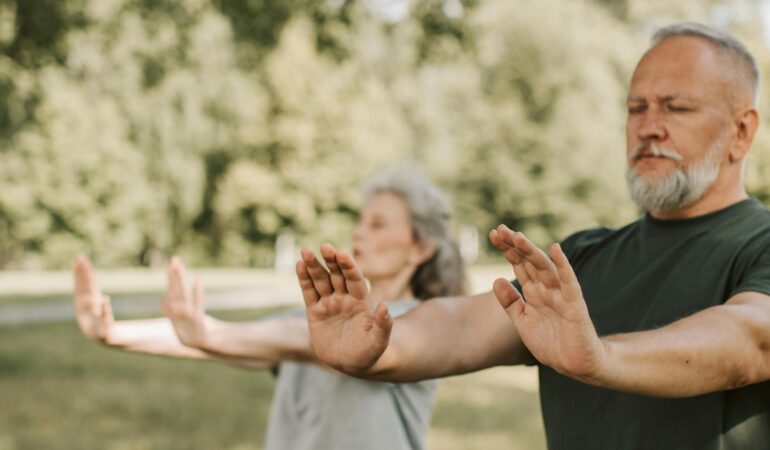
 At the YMCA on Sunday mornings, I stand in the front row of Peter’s tai chi class, following his movements as he demonstrates the form with effortless grace.
“Sink the qi. Let the movement flow from here,” he says, patting his belly. “Keep it loose.”
When we relax, he explains, we free up power. We have more energy to move appropriately.
When he sees our faces tight with concentration, he says, “Smile. It’s not so bad. It’s just tai chi.”
The Lion in the Room
I’m on the phone with Tim, my editor, for our weekly call, when I notice my heart is racing. I pushed really hard this week to finish a new chapter to show him, and I was writing feverishly all morning before our call.
As I feel this anxiety lodge in my body, I realize I used to feel like this all the time.
For years, sitting down to write meant preparing for battle. Annie Dillard, in The Writing Life, likens a work in progress to a “feral lion that grows in strength.” If you skip a day, she writes, you are rightly afraid to open the door to your room. You enter with a chair, like a lion tamer, ready to reassert mastery over the beast.
That was me. Sitting at my desk feeling panicky, certain I was going to fail, was not uncommon. The worry was constant: Could I trust the process? Would ideas flow? Or would each session be filled with frustration and failure to capture the idea that danced just out of reach?
When I’m chasing an idea, when I’m forcing the words, when I’m trying to wrangle the lion—that’s when the work feels impossible. My body tenses. My mind locks up.
But when I relax, when I trust that the words will come, that the process will unfold, the work flows. I find what I’m looking for without even knowing I was looking for it.
Katherine Mansfield, master of the short story, wrote: “I sometimes wonder whether the act of surrender is not one of the greatest of all… Dear heaven, how hard it is to let go—to step into the blue. And yet one’s creative life depends on it and one desires to do nothing else.”
As in tai chi, the power comes from letting go, not holding on.
What Relaxation Looks Like in Practice
Relaxation in writing isn’t passive. It requires intention and practice.
I set a Pomodoro timer for 25 minutes and then make myself take a five-minute rest to stretch. The break feels counterintuitive when I’m in the middle of a good sentence, but the softening makes space for what comes next.
Some days a ritual works: I sip coffee, listen to a song, then sit before the screen for five minutes in stillness. I imagine stepping into a portal, crossing into the other land I’m creating. This signals to my nervous system that we’re safe here. That this is the work we know how to do.
I stop after a couple of hours, even when it’s going well. Especially when it’s going well. I’ve learned to trust that the ideas will be there the next day, that walking away at the peak doesn’t mean losing momentum—it means preserving it.
None of this looks like discipline in the traditional sense. There’s no forcing, no white-knuckling through the hard parts. It’s discipline of a different kind—the discipline to trust, to rest, to let the process unfold in its own time.
Mastery Without Chasing It
I started going to the tai chi class about a year ago and surprised myself by standing right up front, next to the instructor (I’m not a front-row-comfortable person)—only because this was the only place open where I could see him.
At first, I was completely lost. I couldn’t follow the movements. I felt awkward and ungainly. And I couldn’t go consistently. There was a stretch of several months when I was dealing with an illness that made it hard to do even these gentle movements.
Since the new year, the class has been filled with new faces and lots of first-timers. Last week, after class, I began chatting with the woman behind me. This was her third class. She told me she was beginning to catch on. As we walked out, still chatting, she thanked me a couple of times.
I found this baffling until she asked, “Do you teach other classes here too?”
I told her no, I’m not a teacher.
“Oh, but you’re Peter’s helper, right?”
She assumed that because I stand in the front next to Peter and know the movements, I’m some kind of class assistant.
Actually, there’s no way I could do the tai chi form on my own. “I just follow him,” I said.
Without realizing it, without striving, just with repetition and time and showing up, I’ve learned to relax into the movements.
I’ve gained a small degree of mastery.
This is writing too: repetition, practice, going through the motions. Most of all, showing up.
Balancing Work and Rest
I’ll admit, pushing out a chapter this week felt good. I like to test myself like that from time to time. It’s like working a muscle that’s stronger than the inner editor and procrastinator.
But the energy expended is real. After that sprint, I’m staring at a blank page. I can’t sustain that level. I’m in rest mode.
So I practice tai chi. I write this blog instead of a new chapter. I walk my dog. I wait. I move gently. I rest in trusting my level of mastery.
The lion in the room isn’t quite so feral anymore, not because I’ve beaten it into submission, but because I’ve learned to move with it. To trust that even when I can’t see the next move, the energy knows where to flow. I just have to follow.
As Peter says, “Smile, it’s not so bad.” It’s just writing.