 Tammy Letherer
 My husband and I were watching the TV show The Pitt when the main character made a passing reference to Sisyphus. A few days later, I came across a literary publication called Sisyphus.
Two mentions in one week were enough to get me thinking about boulders.
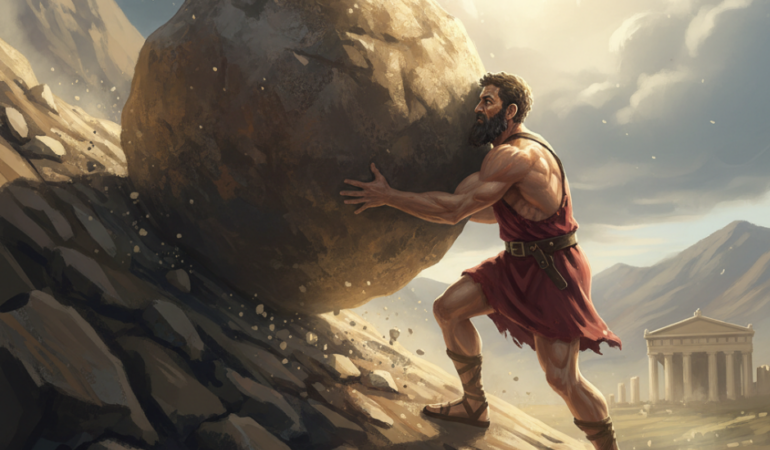
You probably know the myth: Sisyphus, punished by the gods for his trickery, is condemned to push a boulder up a mountain for eternity. Every time he reaches the summit, the boulder rolls back down. He descends, shoulders it again, and pushes. Forever.
It’s meant to be the ultimate punishment—futile, endless labor with no hope of completion or rest.
But philosopher Albert Camus reframed it. In his 1942 essay The Myth of Sisyphus, he argues we must imagine Sisyphus happy. Not happy despite the boulder, but happy because of it.The Absurd Hero
Camus saw Sisyphus as the ultimate “absurd hero.”
Why?
First, Sisyphus is fully aware that his task is meaningless. The gods didn’t just condemn him to push a boulder—they condemned him to know it’s pointless. But that awareness is actually his power. He sees the absurdity clearly and continues anyway. That clear-eyed recognition transforms him from victim to agent.
Second, the real moment of freedom comes during the descent. After the boulder rolls back down, Sisyphus has to walk down the mountain to retrieve it. He has no choice—the gods have condemned him to push forever. But in that pause between the rock rolling away and shouldering it again, he’s not straining under its weight. He can think. He can contemplate his situation. He can even scorn the gods who punished him. In that moment of awareness, he becomes superior to his fate. He can’t escape the boulder, but he can own his relationship to it.
Third, the struggle itself creates the meaning. Sisyphus doesn’t need the boulder to stay at the top. He doesn’t need external validation that his work matters. The pushing itself—the effort, the engagement with the task—is enough to fill his heart.
Camus concludes: “One must imagine Sisyphus happy.”
Writers Must Be Absurd Heroes Too
Like Sisyphus:
- Writers don’t need the bestseller, the prize, or the validation to find meaning. The daily practice of wrestling with words is where meaning lives.
- The absurdity of the task doesn’t diminish its value. We write a book and then another. We revise endlessly. We build platforms that need constant feeding. The work is never done. That’s not a bug—it’s a feature.
- Consciousness of the struggle gives us power over it. When we can see clearly that publishing success is partly luck, that the algorithms are rigged, that very few writers make a living wage—and we choose to write anyway—we’ve claimed our boulder.
- We create meaning through commitment to the work, not through achieving a final goal. There is no summit where we plant a flag and rest. There’s only the next sentence, the next story, the next push up the hill.
Every Writer Has Their Own Boulder
The beauty and the frustration of the writing life is that we each push different boulders. Some are assigned to us. Some we choose. Here are just a few:
The Health and Energy Boulder
2025 was a rocky path for me—I spent months recovering from reactivated Epstein-Barr virus. Some days, completing even the smallest task felt Sisyphean. On those days, the writing boulder sat untouched. The practice has been showing up to whichever boulder demands my attention, not the one I think I should be pushing.
The Comparison Boulder
There was a woman who used to sing at my church who was amazingly talented, upbeat, and gave each performance her all. I admired and envied her. Then one week she admitted that after church, she went home, poured a shot of bourbon, and retreated to her quiet cocoon to recharge.
I was stunned to hear this. I had assumed she was always “on.” That she naturally had bottomless wells of energy and charisma. Learning the truth, that she needed recovery time, just as I would, gave me permission to embrace my own process.
We never really know what preparation or recovery it takes for other artists. We see the performance, not the boulder they pushed to get there.
The Rejection Boulder
As an alum of Indiana University, it was fun watching the Hoosiers win the national football championship. I especially enjoyed learning more about quarterback Fernando Mendoza, winner of the Heisman Trophy. Apparently, he began as a mediocre player and was rejected by countless football programs. He could have given up. Instead, he kept pushing and showing up even when the rock rolled back down.
That’s what we do with rejection, isn’t it? Query letter after query letter. Contest after contest. Submission after submission. The boulder rolls back. We walk down the mountain. We pick it up again.
The Hopelessness in Turbulent Times Boulder
And then there’s the boulder many of us are pushing right now—the exhaustion and outrage and surreality of current events. The heartsickness at what our country has become. The hate, the lies, the cruelty packaged as policy.
It’s easy to think our writing is frivolous when democracy and decency seem to be crumbling. How can we retreat into our art when the world is burning? What’s the point of one more story when everything is falling apart?
It’s absurd!
But Sisyphus didn’t stop pushing because the task was absurd. The meaninglessness didn’t defeat him—it freed him to create his own meaning within the absurdity.
Our stories matter precisely because everything feels meaningless right now. Our insistence on beauty and truth and careful language in a world drowning in ugliness and lies—that’s not frivolous. That’s rebellion. That’s us refusing to let the darkness win.
So on some days we push the boulder of activism—we show up, we resist, we document, we bear witness. Other days we push the boulder of creation—we write the sentence, we craft the scene, we build the world on the page. Both matter. Both are forms of pushing back against the absurdity.Is It Worth It?
I can’t answer that for anyone else. Some days I can’t even answer it for myself.
But I keep showing up to the hill. I keep choosing my boulder. And on the days when I can barely move it an inch, I remind myself: The work is never done. The hill is never conquered. There is no final summit.
There’s only the choice to push again—not because we have to, but because we’ve decided the pushing itself is enough.
That’s rebellion. That’s agency. That’s freedom.
One must imagine the writer happy.
Until next time,