 Tammy Letherer
 Last week in Chicago, my hometown, Black Hawk helicopters circled overhead as federal agents conducted raids in apartment buildings, breaking down doors in the middle of the night and detaining residents—including U.S. citizens—for hours. Neighbors began patrolling school drop-offs and pick-ups, protecting children and mothers from ICE agents. In Logan Square, where my son lives, a convoy of armed vehicles rolled toward a Hispanic grocery store and threw tear gas into the parking lot. Just three blocks north, in Evanston, Mayor Daniel Biss called the raids what they are—abductions—and told the agents to “get the hell out of Evanston.” And here in Rogers Park, where I live, vendors have packed up their tamale stands, desperate to get off the streets. My husband and I now wear whistles around our necks, armed with instructions on how to document unlawful detentions.
Against this backdrop, I boarded a plane to Santa Fe for the Writer Unboxed Unconference—a gathering titled “Keepers of the Flame.” I was determined to take a break from the news, from social media, from the relentless stream of divisiveness, and immerse myself in the craft of writing. But part of me felt guilty. How could I justify spending time on stories when my own neighborhood was under siege?
I expected to enter a writing bubble, to talk about fiction and make-believe. But as each speaker took the podium, it was clear that there would be no separation between us as writers and the world we inhabit, no shying away from the fear and dismay we all feel as democracy crumbles. In fact, one of the first speakers, Donald Maass—author and founder of the Donald Maass Literary Agency—spoke on “Writing Unsafe Truth.” He said something that stopped me cold:
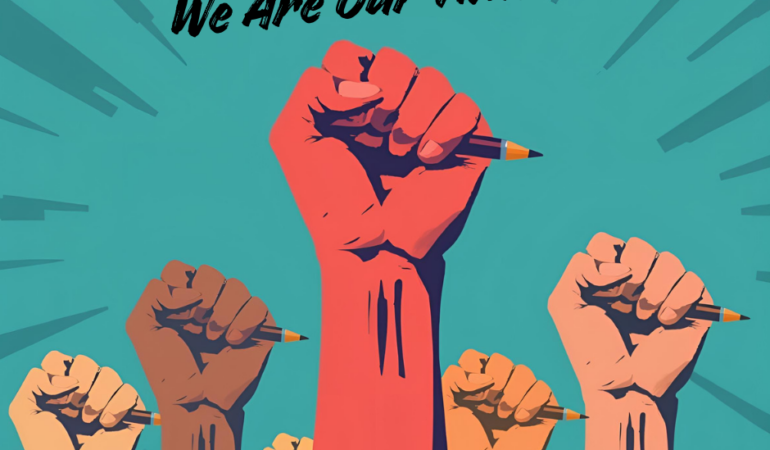
We are our times.
We don’t check cultural context at the door. Writers may dream of “a room of one’s own,” but if that room is in a building that is on fire, there are sure to be ashes on the page.
It was startling. Here was not permission to escape—but permission to fully inhabit storytelling as a vital pursuit.
Maass positioned writers and storytellers as the most powerful people in the world. Why? Humans are hardwired to learn through story. It’s not just one way we process information—it’s the only way we truly integrate experience into meaning.
Storytellers seek meaning in everything. We possess the gifts these times desperately need: curiosity, deep listening, skepticism, observation, and the ability to discern emotional truth.
Storytellers take nothing for granted. We question everything. We’ll be the first to say, “That doesn’t make sense.” What a needed skill in this time when fiction has become fact and facts are treated as make-believe!
Storytellers are also readers. We’ve absorbed the stories of similar times in the past—when people were terrorized, disappeared, targeted because of race or creed. We are informed by history in ways that allow us to recognize patterns, to see where things are heading. We can say, “I’ve heard this story before, and I know how it ends if we don’t change the narrative.” Storytellers carry the cautionary tales, the survival stories, the testimonies of those who came before. We know the arc of these stories because we’ve read them, studied them, been haunted by them.
Our stories hold a mirror to human nature. Whether we write about true events around us or create stories as pure entertainment or escapism, both matter deeply.
The science backs this up. Research consistently shows that creative expression helps people cope with stress and despair, alleviating the burden of chronic mental distress. When we make art, our brains release endorphins that provide relief from emotional pain. Studies have found that just 15 minutes of creative activity can elevate mood and reduce cortisol levels. But it’s more than brain chemistry. Art provides an outlet for emotional turmoil that’s too painful to bear in silence.
This is why our creative work isn’t trivial. This is why it matters. Especially now.
So: How will you be a keeper of the flame?
Maybe it’s the novel you’ve been putting off because “the world has bigger problems.” Maybe it’s the painting gathering dust in your closet. Maybe it’s the song you’ve been too afraid to share. Whatever your creative pursuit is, it’s not separate from what’s happening around us. It’s not a distraction from the work that matters. It is the work that matters.
You are your times. Your creative work is how you make sense of chaos, how you process fear, how you bear witness. It’s how you remind yourself—and others—what it means to be human when everything around you feels inhumane.
The world doesn’t need you to stop creating. In times of darkness and division, those who create, who tell stories, who insist on beauty and meaning and truth, are literally keeping the light alive.
The world needs you to create more fiercely than ever.
Keep your flame burning.
“Those who tell the stories rule the world.” — Hopi proverb
Until next time,